
Understanding RFID:physics, standards,and operational reality.
Radio Frequency Identification (RFID) enables remote, contactless detection and data capture of physical items without requiring optical line-of-sight. Here is an objective, technical overview of how it works, its physics constraints, and where it delivers decisive business value.

The 3 core elements of an RFID system
Passive UHF tags contain zero battery. The electromagnetic wave transmitted by the reader antenna induces a micro-current in the tag antenna via inductive/radiative coupling. The chip powers up and modulates its reflection back to the reader (backscattering principle).
1. The RFID Tag (Transponder)
A microchip coupled with a conductive antenna. Attached directly to boxes, pallets, garments, or metallic machinery.
2. The Interrogator (RFID Reader)
Emits radio waves through directional antennas to power tags and decode their response in fractions of a second.
3. Middleware & Enterprise ERP
Filters duplicate reads, aggregates EPC serial numbers, and pushes validated stock events directly to your ERP or WMS.
0
Battery in a passive tag: practically unlimited lifespan
0
Line-of-sight required: reads through cardboard, fabrics, and plastics
100s
Of tags captured per second by an industrial UHF reader
1969
First patents; now a globally standardized mature technology
Indicated figures represent typical industrial usage in the UHF band (860–960 MHz). Actual performance depends on tag inlay design, substrate material, and reading environment.
Frequency bands: LF, HF, UHF, and Microwave
Low Frequency
125 – 134 kHz
Few centimeters
Impervious to liquids and metal interference
Livestock identification, vehicle immobilizers, basic access control
High Frequency
13.56 MHz
Up to ~10 cm
Readable by smartphones, global ISO 14443 / 15693 standards, high security
Smart badges, transit ticketing, libraries, contactless payments
Ultra High Frequency
860 – 960 MHz
Up to 10–12 meters and beyond
Mass bulk reading, ultra-fast scanning, long range, lowest cost per tag
Logistics, warehouse inventory, retail apparel, returnable assets, archives
Active Transponders
2.45 GHz & 5.8 GHz
100 meters+
Very long range, high data rates, real-time telemetry sensor payload
Highway automated tolling, container port yard RTLS, fleet tracking
Detailed Comparison: Barcodes vs UHF RFID
| Critère | Code-barres / 2D | RFID UHF (EPC Gen2) |
|---|---|---|
| Line-of-sight requirement | Strictly required: scanner must physically aim at label | Not required: reads through packaging, boxes, and fabric |
| Reading speed | 1 label at a time, sequential manual alignment | Up to 700+ tags per second simultaneously in bulk |
| Durability in dirty environments | Fails if stained, torn, creased, or obscured by dust | Embedded chip readable even covered with grease, dirt, or paint |
| Individual unit uniqueness | Standard barcodes only identify the product SKU (batch) | Every tag carries a unique serial number (serialized asset tracking) |
| Read / Write capability | Static once printed; cannot be updated | Rewritable user memory bank in field conditions |
| Unit tag cost | Fraction of a cent (standard thermal printed paper) | Few cents for standard UHF inlays (higher for on-metal rugged tags) |
5 Common Myths Debunked
Dispelling misconceptions with rigorous industrial physics.
« RFID completely replaces barcodes everywhere »
False. In high-velocity retail checkout with single item optical scan, 1D/2D barcodes remain unbeatable in cost. RFID excels where mass scanning, non-line-of-sight, or serialized lifecycle tracking is needed.
« RFID is impossible near liquids or metals »
False. While bare inlays detune on metal, modern engineered "On-Metal" tags incorporate magnetic dielectric spacers enabling read ranges of 8+ meters directly mounted on steel pipes or server chassis.
« Passive RFID tags emit harmful constant radiation »
False. Passive tags have no battery, no oscillator, and emit nothing until energized for a fraction of a millisecond by the interrogator field within standard telecom regulation limits.
« RFID implementation requires changing our existing ERP »
False. Professional RFID middleware acts as an automated data collector, pushing clean inventory events into your existing SAP, Odoo, or Sage without altering core business workflows.
« You can calculate RFID performance from datasheets alone »
False. Actual read rates depend on product density, packaging water content, antenna orientation, and forklift speeds. Real testing with your actual products in your facility is essential.
Where RFID Delivers Decisive ROI
High-impact deployment scenarios in Algerian industry and retail.
Bulk Inventory of Packaged Goods
Scan hundreds of palletized boxes without opening cartons or de-stacking goods. Turns multi-day inventory shutdowns into 2-hour routines.
Returnable Transport Item (RTI) Tracking
Trace pallets, plastic crates, stillages, and gas cylinders across distribution cycles, eradicating unrecorded losses and deposit disputes.
Automatic Shipping Dock Verification
Forklifts driving through RFID dock portals automatically validate that the loaded pallets match the delivery order before the truck leaves.
Our Turnkey Deployed Solutions
Explore how we apply these RFID technologies to specific enterprise operational workflows.

RFID Inventory & Asset Tracking
Instant warehouse stock counts, automated discrepancy reconciliation, and asset tracking using rugged UHF RFID handhelds and fixed portals.
Explore solution
Intelligent Physical Records Archiving
Locate paper archives in seconds, eliminate lost documents, and audit file borrowings with UHF RFID tracking.
Explore solution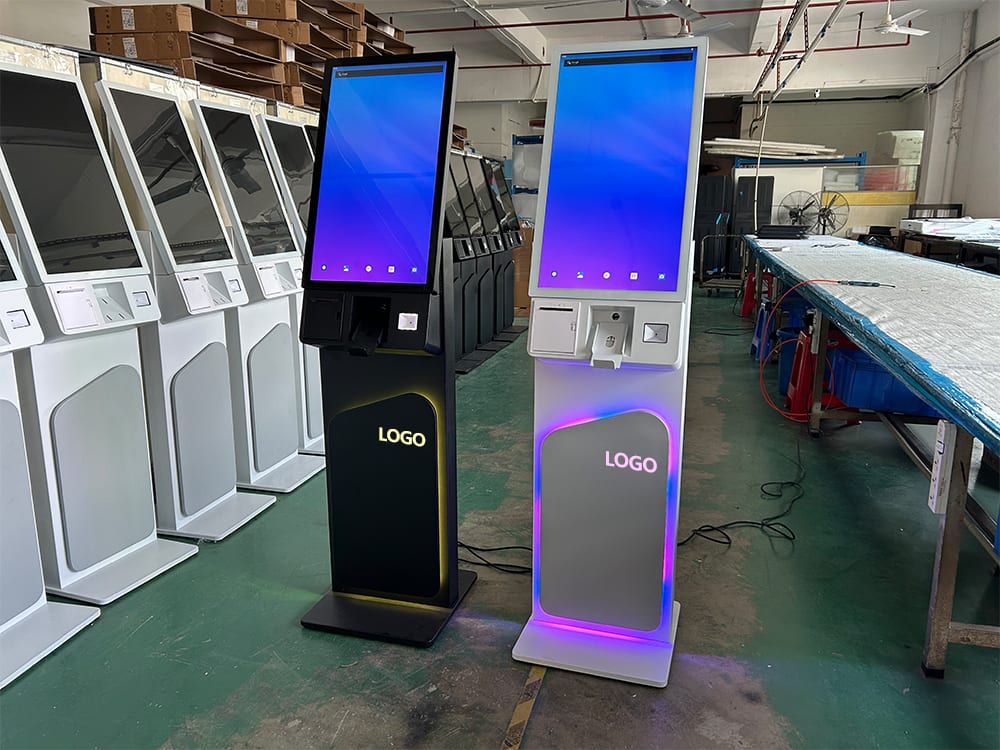
Customer Queue Management System
Interactive ticket kiosks, dynamic LCD calling displays, desk consoles, and real-time supervisor performance dashboards.
Explore solution
Pneumatic Tube Transport System
Automated pneumatic tube networks for hospitals, clinical laboratories, banks, and manufacturing plants.
Explore solution
RFID Smart Library Automation
Self-service checkout kiosks, automated book drop returns, shelf-reading wands, and RFID anti-theft security gates.
Explore solution
Biometric & RFID Access Control
Motorized tripod turnstiles, speed gates, biometric terminals, RFID badge readers, and centralized attendance management.
Explore solution
Have a project or technical question?
Share your operational requirements: our engineers evaluate technical feasibility, establish pilot parameters, and deliver a detailed quotation. On-site demonstrations with your assets are free of commitment.
- Phone : 0770 13 33 35
- Email : contact@megastore-tech.com
- Address : Boushaki, Bab Ezzouar, Alger